
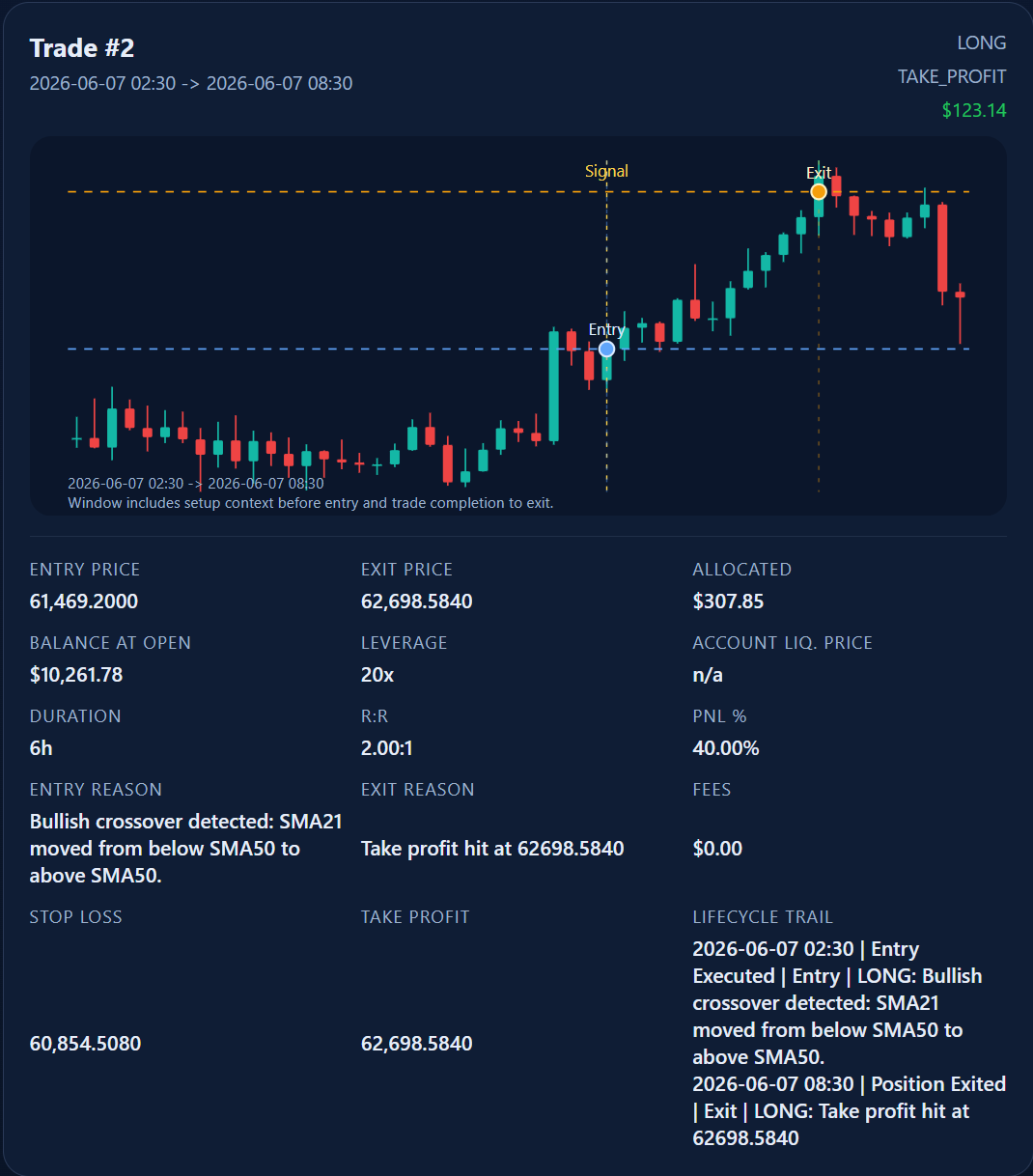
CostsVisibleReportsHTML exportReviewTrade trail
Run realistic tests, inspect fragile assumptions, compare optimizer candidates, and export HTML evidence before a strategy reaches Demo or Live Real.
OttoTrader keeps the backtest, assumptions, review trail, and report output close enough that a result can be challenged before it is trusted.
Test a strategy with visible fees, slippage, spread, funding, liquidation, and exchange assumptions where supported.
Review trades, drawdown, win/loss behavior, costs, and warnings instead of stopping at one clean equity curve.
Use validation splits, rolling windows, Monte Carlo paths, robustness checks, and lookahead audits where supported.
Keep Full Reports for private retest context and Public Reports for buyer-safe evidence that hides protected logic.
The goal is not a prettier chart. The goal is enough evidence to know what produced the result and what should still be treated with caution.
The result is tied to the settings that created it: historical range, sizing, costs, exchange behavior, and credibility assumptions.
Full Reports preserve private review context. Public Reports are buyer-safe, non-importable, and designed to avoid exposing protected logic.
TradingView webhook strategies are checked in Demo and live diagnostics because historical alerts are not replayed into OttoTrader.
Optimizer work is useful only when the best candidate is still tied to its assumptions, validation basis, and final review path.
Strategy Optimizer can compare parameter combinations, pairs, timeframes, and settings while keeping accepted candidates and warnings visible.
Validation modes help separate attractive full-range results from candidates that hold up under stricter windows and scoring rules.
Winning candidates should be rerun and reviewed before moving into Demo, Live Real, or marketplace-style proof.
Historical simulations can miss liquidity, outages, latency, order-book queueing, exchange-side behavior, delistings, and future market changes. OttoTrader makes assumptions visible so you can use the result as a decision input rather than a promise.
OttoTrader is strongest when every generated or imported strategy still has to pass product rules, backtests, and user review.